
Full-broadcast and partial chip finishes
Epoxy Flake Floors in Sioux Falls, SD
A speckled, textured finish that hides winter grit between cleanings and gives tires and boots something to grip.
- Free on-site estimate with a slab moisture test
- Itemized written quote before any work begins
- Every floor diamond ground and repaired before coating
Why Flake Is the Default in Sioux Falls Garages
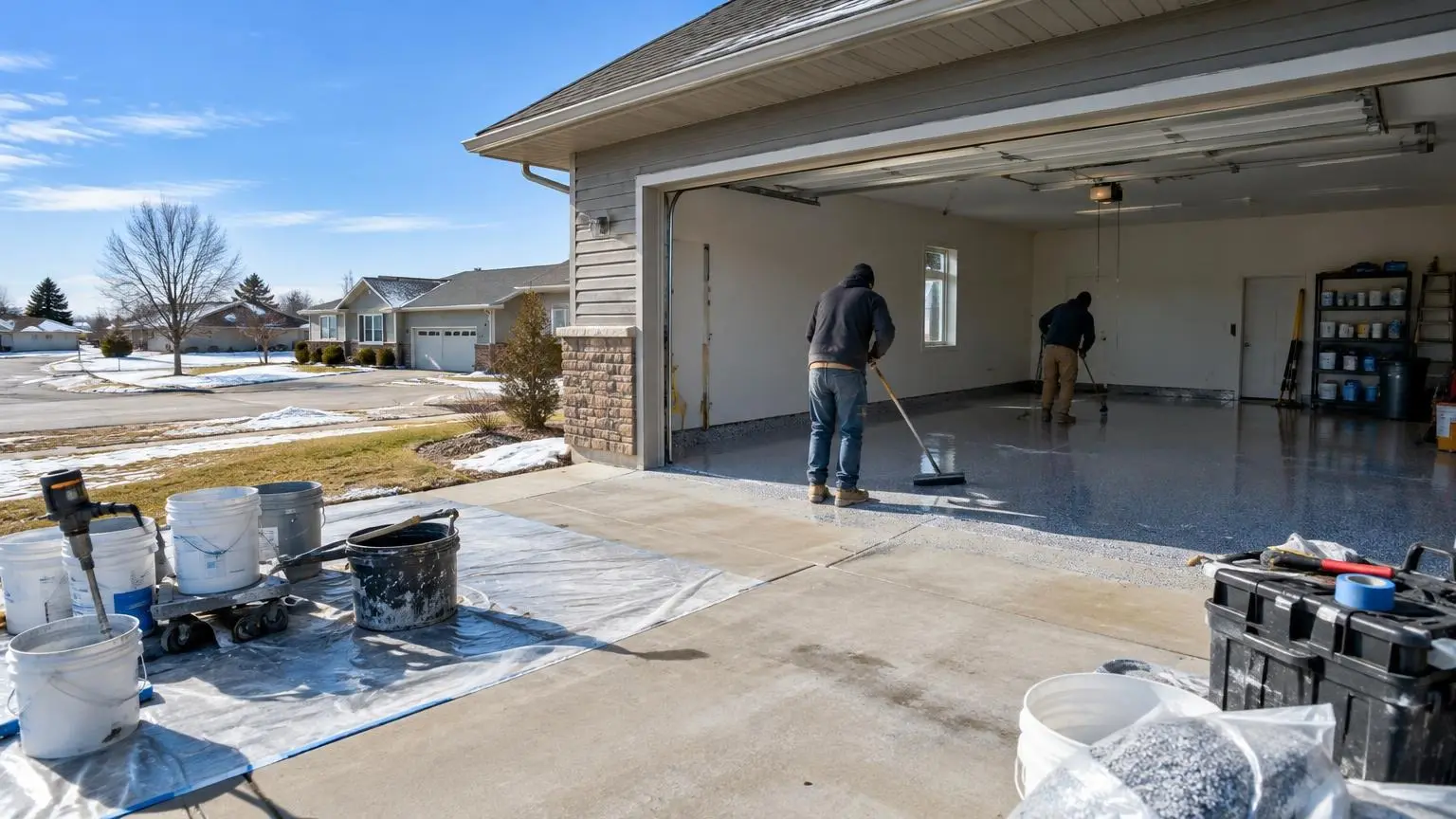
Epoxy flake floors, also called chip floors, are what most Sioux Falls homeowners pick for the garage. Colored vinyl chips are scattered into a wet base coat until it is covered, then the loose flakes are scraped off and a clear topcoat seals the surface. The result has small texture across the whole floor and a pattern that hides the dried salt, sand and tire marks a winter leaves behind.
What the flakes do
- Hide dirt: a multi-color blend makes salt crust and dust far less visible than on a solid color.
- Add grip: the chip edges under the topcoat give a slight texture, which helps with wet tires and boots.
- Add build: a full broadcast adds thickness to the system.
- Cover uneven color: patched cracks and ground areas disappear under the chips.
Full broadcast or partial
In a full broadcast, flakes cover the base coat completely. That is the usual choice for garages because it hides the most and gives the most texture. A partial or light broadcast scatters fewer chips over a solid base color. It looks cleaner and more modern but shows dirt sooner. Some people use a full broadcast in the garage and a lighter one in a basement or shop office.
Choosing colors for a Sioux Falls garage
Mid-tone gray, tan and brown blends hide the white residue road salt leaves and the gray dust from sand. Very dark blends show salt rings. Very light blends show tire marks. We bring physical samples to the estimate because the overhead lights and the daylight through the door change how a blend looks.
The layers in a flake system
1. Diamond grinding of the whole slab, with cracks and spalls filled. 2. A base coat, usually epoxy or polyaspartic, rolled out in sections. 3. Flakes broadcast by hand into the wet base until it will not take any more. 4. Scraping and vacuuming the loose chips once the base has cured. 5. A clear topcoat, often polyaspartic, for UV, chemical and abrasion resistance.
Where flake floors work outside the garage
Flake systems also suit basement laundry rooms, utility rooms, mudrooms, home gyms and shop floors. In a basement we test moisture first and may use a different primer. In a shop with heavy equipment we may use a thicker base or add a second topcoat.
Caring for a flake floor
Sweep or use a dust mop for grit, and wash with water and a mild cleaner. In winter, push meltwater out and rinse the salt off every few weeks. Avoid acid cleaners and citrus degreasers that can dull a topcoat.
What This Covers
Each flake floor is built in layers over a ground, repaired slab.
Full-broadcast flake
Chips cover the base coat completely for the most texture and the most dirt hiding.
Partial broadcast
A lighter scatter of chips over a solid color for a cleaner look.
Custom blends
Chip colors and sizes chosen from samples in your own space.
Stem wall coating
The wall curb and steps finished to match the floor.
Typical Epoxy Flake Floor Costs
| Item | Published range |
|---|---|
| Epoxy, installed, per square foot | $4 to $10 |
| Polyaspartic, installed, per square foot | $5 to $12 |
| Flakes or custom colors, add-on | $0.50 to $2.00 per sq ft |
| Two-car garage, epoxy | $1,600 to $5,800 |
| Two-car garage, polyaspartic | $2,000 to $6,900 |
National ranges from HomeGuide's epoxy and polyaspartic cost guides. A full broadcast uses more material and labor than a solid color. Your written estimate is the price.
How It Works
1. Pick a blend
We bring flake samples to the estimate and check them in your lighting.
2. Prepare the slab
Grinding, vacuuming and crack and spall repair across the whole floor.
3. Base and broadcast
The base goes down and flakes are broadcast by hand until the surface is covered.
4. Scrape and seal
Loose chips are removed and a clear topcoat locks the surface in.
Epoxy Flake Floors Questions
Are flake floors better than a solid epoxy color?
For a garage, most people find flake easier to live with because it hides salt and dust and adds grip. A solid color looks sleeker but shows marks sooner. Both use the same base and topcoat, so durability is similar.
Do flakes make the floor rough?
A full broadcast with a topcoat has a light texture, a bit like an orange peel. It is easy to sweep and mop. If you want more grip, we can add aggregate to the topcoat.
How much more does flake cost than plain epoxy?
HomeGuide lists decorative flakes and custom colors at about $0.50 to $2.00 per square foot added to the base system cost.
Can a flake floor go in a basement?
Yes, after a moisture test. Flake works well in laundry rooms, gyms and storage areas. If the slab shows moisture, we use a primer made for it or tell you to deal with the water first.
Epoxy Flake Floors Service Areas
- Epoxy Flooring in Sioux Falls, SD
- Epoxy Flooring in Brandon, SD
- Epoxy Flooring in Harrisburg, SD
- Epoxy Flooring in Tea, SD
- Epoxy Flooring in Hartford, SD
- Epoxy Flooring in Crooks, SD
- Epoxy Flooring in Renner, SD
- Epoxy Flooring in Dell Rapids, SD
- Epoxy Flooring in Baltic, SD
- Epoxy Flooring in Garretson, SD
- Epoxy Flooring in Colton, SD
- Epoxy Flooring in Humboldt, SD
- Epoxy Flooring in Valley Springs, SD
- Epoxy Flooring in Lennox, SD
- Epoxy Flooring in Worthing, SD
- Epoxy Flooring in Canton, SD
- Epoxy Flooring in Chancellor, SD
- Epoxy Flooring in Beresford, SD
- Epoxy Flooring in Montrose, SD
- Epoxy Flooring in Luverne, MN
- Epoxy Flooring in Larchwood, IA
- Epoxy Flooring in Inwood, IA
Get a Epoxy Flake Floors Estimate
Free on-site estimates for flake floors in Sioux Falls, with samples brought to you.